The lecture brought together government leaders, academics, traditional leaders, students and members of the public to explore how indigenous African languages can strengthen access to justice, constitutional democracy and social transformation.
The Public Lecture forms part of UMP's flagship dialogue platform, established by Vice-Chancellor and Principal Professor Thenjiwe Meyiwa to foster meaningful engagement among academics, policymakers, community leaders and thought leaders on decoloniality, social justice, knowledge transformation and African-centred scholarship.
Welcoming delegates, Professor Meyiwa acknowledged the Deputy Minister, government representatives, members of the University Council, executive management, traditional leaders, community members and guests attending both in person and online. She said Mpumalanga's rich cultural and historical heritage provided an appropriate setting for a conversation on language, justice and inclusive development.
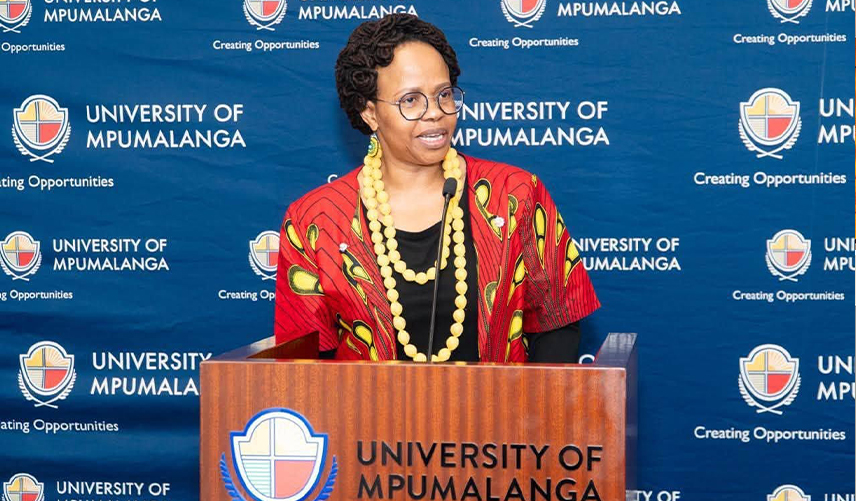 Professor Meyiwa mentioned that indigenous languages should move beyond interpretation and translation to be debated and developed.
"Language shapes whose voices are heard, whose knowledge is recognised and ultimately who has meaningful access to justice. Justice cannot truly be realised if it is delivered in languages that many people neither speak nor understand. For justice to be accessible, it must be communicated in the languages of the people," she said.
Professor Meyiwa remarked that meaningful transformation requires indigenous African languages to move beyond interpretation and translation to become languages through which law is taught, interpreted, debated and developed.
"We must move beyond translating legal processes. Indigenous languages should become languages through which law is taught, interpreted, debated and developed. That is how we build a justice system that belongs to all our people."
Drawing on examples from Botswana, Rwanda, Tanzania and Kenya, she noted that multilingual justice systems demonstrate how indigenous languages can strengthen democratic participation and improve access to justice. She also highlighted Kiswahili as a unifying African language and called on universities to preserve indigenous knowledge systems while advancing African languages in teaching, research and public discourse.
Delivering the keynote address, Honourable Andries Nel turned attention to the constitutional and practical implications of linguistic inclusion within South Africa's justice system. Reflecting on the country's democratic journey, he noted that Section 6 of the Constitution recognises South Africa's 12 official languages, including South African Sign Language, but stressed that constitutional recognition must be matched by practical implementation.
"Our Constitution recognises our linguistic diversity as one of our greatest strengths. The challenge before us is ensuring that this recognition translates into practical measures that enable every South African to participate equally in public life and in the administration of justice," he said.
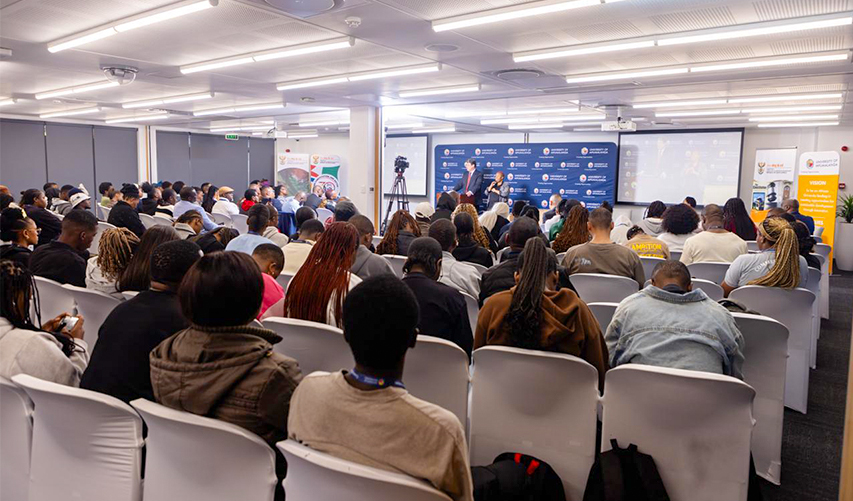 The lecture concluded with a panel discussion.
The Deputy Minister explained that language is not merely a means of communicating legal information, but also shapes legal concepts, interpretation and jurisprudence.
"Language is not simply a vehicle through which the law is communicated. It shapes legal concepts, influences jurisprudence and determines how justice is understood and experienced by society. A legal system that relies exclusively on dominant languages risks excluding those whose lived realities are expressed through indigenous languages."
He added: "The advancement of indigenous languages is not merely a cultural objective. It is fundamental to social justice, equality and constitutional democracy. A justice system that speaks the language of its people strengthens public confidence and reinforces the legitimacy of our democratic institutions."
Honourable Nel called for sustained collaboration between government, universities and the legal profession to develop indigenous African languages as languages of legal education, legal practice and jurisprudence.
"We must invest in developing indigenous languages as languages of legal education, legal practice and jurisprudence. This work demands collaboration across institutions to develop legal terminology, scholarly literature and educational resources that strengthen our multilingual democracy."
A panel discussion following the keynote explored the relationship between language, economic development, gender equality and constitutional justice. The discussion reinforced the importance of indigenous African languages in promoting inclusive governance, meaningful public participation and equitable development.
Story by Cleopatra Makhaga. Pictures by JB Creative Cinema. Copyright © UMP.